Finding the right price point—for anything—is part science, part art, part alchemy… and maybe a sprinkle of luck.
Charge too little, and you leave money on the table. Charge too much, and you don’t close the deal. This trade-off is as old as commerce itself, but it’s especially tricky for intangible products like software—particularly when selling subscriptions instead of one-offs and purely product-led (without the benefit of a human sales manager in the loop).
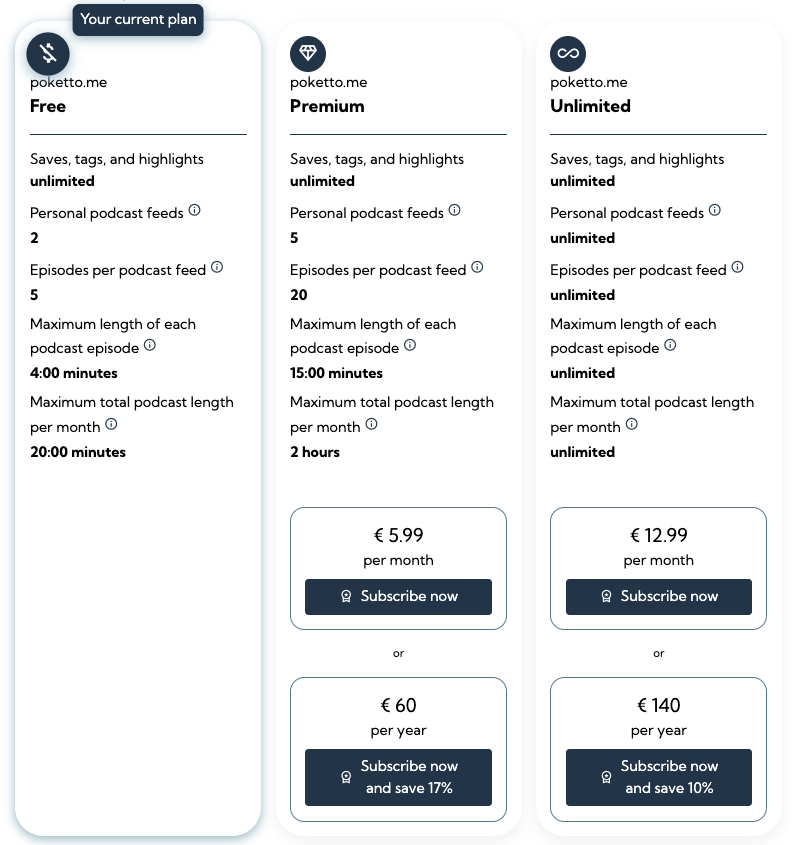
For poketto.me, I built a multi-layered pricing model. Here’s the process I followed:
⬆️I started "bottom up," first establishing my overhead costs. What does it cost me per month to operate the service? What do I pay for cloud infrastructure, web hosting, LLMs, etc.? Fortunately, the save-tag-read use case has a fairly linear cost structure. Regardless of the number of users (within reason), these costs remain fairly consistent.
🔂 Variable costs. The personal podcast feature is trickier—text-to-speech is GPU-intensive and costs me per minute. So I mapped low/medium/high usage scenarios for each plan (free, premium, unlimited) and calculated the average per-user cost. This helped me determine both usage caps and the minimum price I’d need to break even.
↩️ Free user overhead. I then estimated the text-to-speech costs from small/medium/large cohorts of free users. Since free users create real costs, they must be offset by premium and unlimited subscribers. Unlike fixed infra, this overhead varies heavily with usage.
↔️ Profit margins + scenarios. Next, I modeled per-user and overall profit margins across scenarios: stagnation, growth, hypergrowth. How many free users would I need to convert? How much revenue can I trade for annual commitments? What’s my margin for discounts or future affiliate marketing?
🔃 Market check. Finally, I benchmarked my preliminary prices against similar subscriptions. A pure value-based approach didn’t make sense here, but I wanted to sit between “buy-me-a-coffee” Patreon-style creators and Netflix’s mid-tier plan. With all the above, that’s exactly where I landed.
For now—and in combination with how I structured features, usage caps, and upgrade incentives (see TIL #85)—I’m happy with the model. But it’s still early days, and I’ll have to see how it resonates with the market.