Automatic content translation has been a key feature of poketto.me from day one. Why? Because I believe there’s immense value in making content accessible to non-native speakers.
Personally, I’m deeply interested in developments in countries like India, Pakistan, and China — but the best publications from those regions often don’t publish in English. Being able to read and compare both Dawn News (Pakistan) and the Hindustan Times (India) coverage of tensions between the two countries — in English — for example is fascinating.
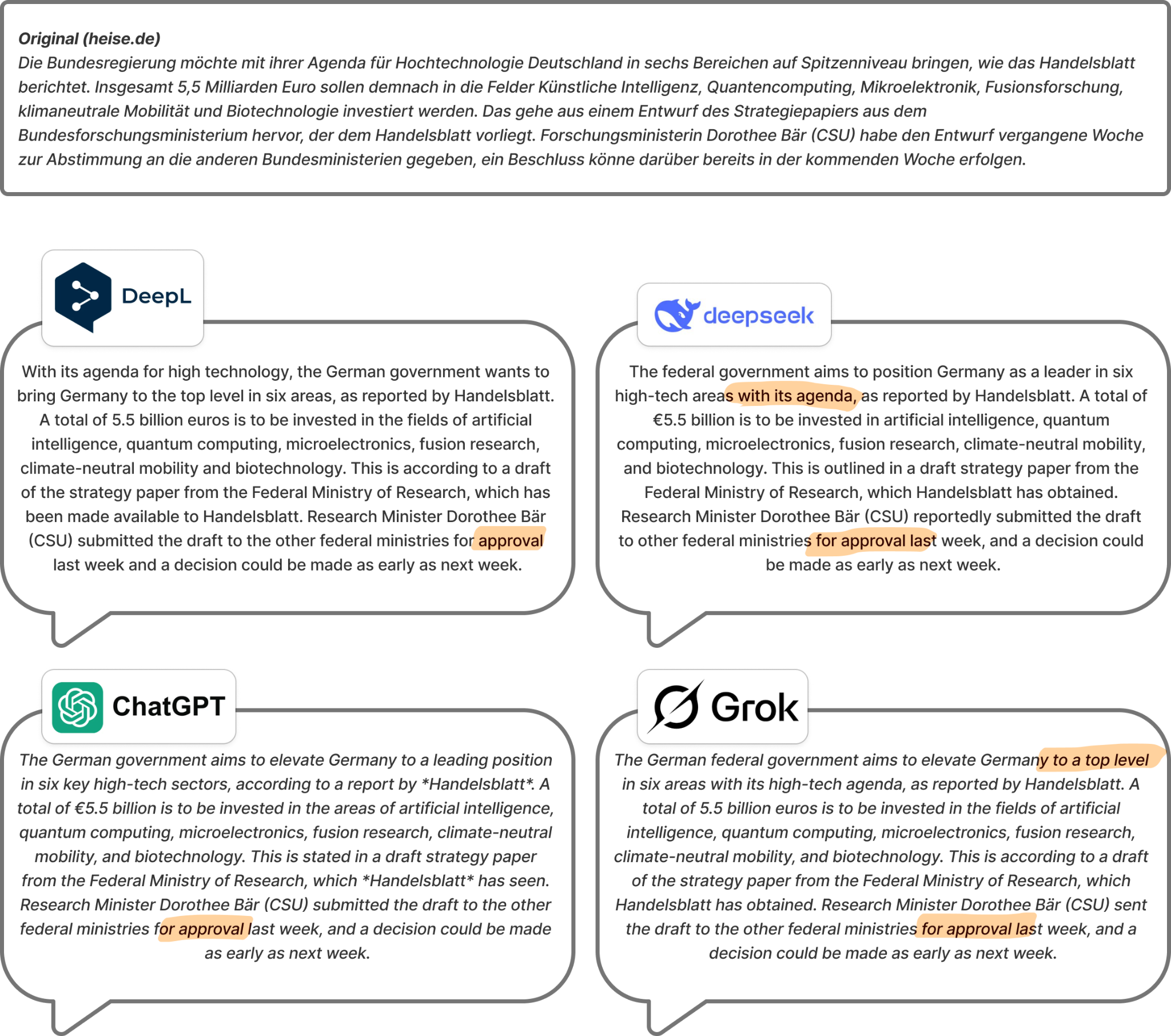
But that raises the question: Which AI tool delivers the best translations?
The answer, unfortunately, is: It depends.
Take the example I’ve attached. The incumbent, DeepL, arguably paraphrased the original text the most, but managed to capture many of its nuances. The general-purpose LLM contenders stayed closer to the original sentence structure but made more noticeable wording mistakes — like DeepSeek’s awkward “…with its agenda…” phrasing. Somehow, it couldn’t grasp that the ‘high-tech agenda’ is the point, not just any old ‘agenda’.
Interestingly, none of the tools got a subtle distinction right: The phrase “zur Abstimmung” is best translated as “for review and further discussion,” not “for approval” — and no tool nailed that.
*What’s next?* For poketto.me, I’ll stick with LLM-based translations for now, despite some rough edges. But long-term, I’m considering a field test: Presenting users with two or three translation options and letting them vote for the version they feel works best.