Anyone remember the 1990s? Back then, if you wanted to buy software, you walked into a physical store, handed over your hard-earned cash, and received a bunch of floppy disks—or, later, a shiny silver CD—in return.
Today, most people don’t pay for the apps they use. Instead, consumers have internalized the notion that software is inherently “free.” We don’t expect to pay for online search, social media apps, fitness trackers, mobile operating systems, or even AI chatbots. How did that come about? The dynamics that led to the devaluation of software are numerous, but a few factors undoubtedly contributed.
- Advertising: Since Google launched AdWords in 2000, many big tech companies have adopted a business model in which an otherwise unrelated third party—an advertiser—ultimately pays the bill rather than the end user of the software.
- Freemium: Others have launched generous “freemium” offerings where a small percentage of subscribers generate enough revenue to subsidize development and operations for everyone else.
- Scramble for market share: VC-backed companies often give away their products for free (or at a huge loss) for years to gain market share and drive competitors out. Uber spearheaded this strategy, which has since been adopted in many “winner takes all” markets, most notably by the current AI behemoths, OpenAI and Anthropic.
- Open source: Individual creators, especially those of free/open-source software, enjoy coding so much that they don’t care about making money from some of their projects. In other cases, for-profit companies pay engineers to maintain these free code bases for their own reasons: They either want to improve their community reputation or have a downstream business model, such as selling support or services.
The point is: Consumers have many reasons to expect software to be free. With poketto.me, I embraced this idea by using a freemium model. While all features are essentially “free forever,” some, most notably text-to-speech, have usage restrictions. A paid tier offers increased usage. I thought that those “premium” users would generate a small revenue stream that would fund the app’s operations.
Sadly, this hasn’t paid off thus far. There’s a lot I could do to optimize my conversion rates for sure, but that’s beside the point. What’s interesting is that when users do upgrade to a paid tier, they don’t do it out of a desire to access the paid features. They do it because they like the tool and feel a desire to support its further development. They want to pay, rather than have to pay.
Thus, with parlametrics I’m exclusively pursuing this funding model. Usage is free. There are no tiers, no pricing, no subscriptions. However, I politely ask users to donate whatever amount they think is fair. Donations can be made on a one-time or monthly recurring basis. Or not at all. As with poketto.me, I don’t expect to earn much income from this project. Instead, I hope to have interesting conversations with people deeply involved in the democratic process, or with journalism, or who want to explore the data that parlametrics surfaces for other reasons. I’m also honestly curious to see how well a donation-based model will work commercially. Stay tuned for updates on this!
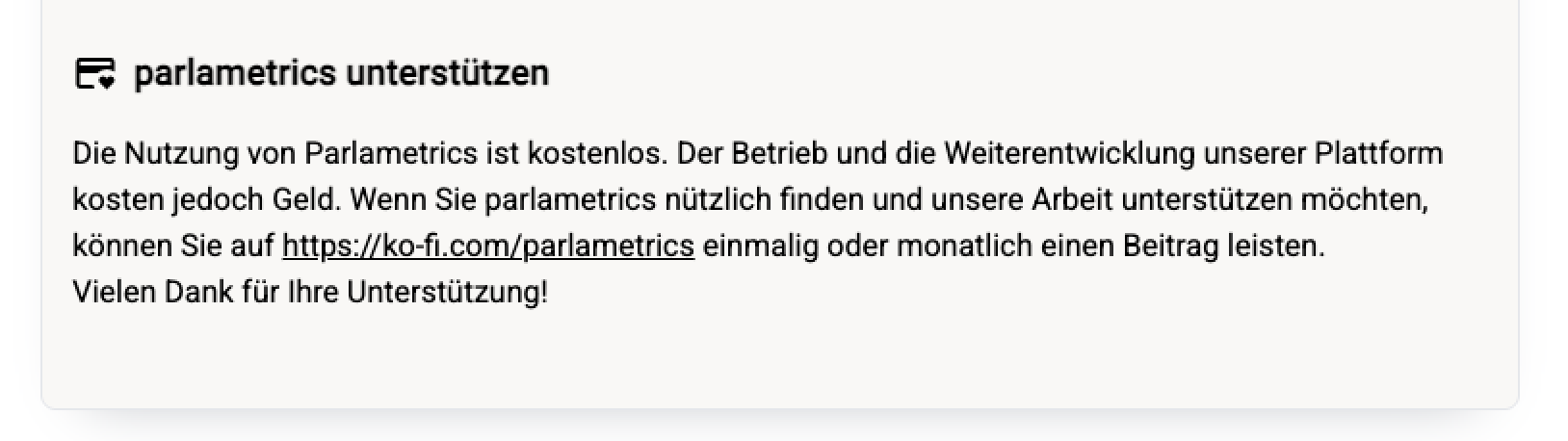
PS: If you want to support parlametrics, head over to https://ko-fi.com/parlametrics. Thanks!